This report was prepared by the Center for USA Lending, a nonpartisan, nonprofit organization working to modernize the U.S. government’s lending enterprise. The center connects stakeholders to build a credit ecosystem where students, homeowners, veterans, farmers and small businesses can access capital through transparent, efficient programs powered by modern technology and infrastructure. This analysis provides objective insights to inform congressional consideration of the Federal Loan Systems Modernization Act.
When federal agencies discuss modernization, the conversation typically centers on infrastructure: replacing mainframes, migrating to cloud platforms, adopting new development frameworks. These are necessary steps, but they’re means, not ends.
True modernization should be measured by its impact on borrowers. Does it make applications faster? Does it reduce the documentation burden? Does it provide clear, timely communication about application status? Does it enable borrowers to manage their accounts without calling a help center?
I. Background and Need for Legislation
The U.S. government is one of the world’s largest creditors. Its direct loan and loan guaranty portfolio exceeds $5 trillion across 20 agencies and includes student loans, housing assistance, small business financing, agricultural credit, veterans’ benefits, and infrastructure financing. This portfolio, however, is not managed as an enterprise. Instead, each agency operates its own loan servicing platforms, applies its own data standards and definitions, and approaches modernization on its own timeline.
This fragmentation is not a new problem, but it is worsening given substantial growth in federal lending and an increasingly constrained operating environment. Agencies that have the budget and will to modernize are procuring new lending systems and technology tools outside any coordinating framework. Meanwhile, the absence of common data standards means the government cannot readily produce a reliable picture of its credit exposure, delinquency trends, or program performance. That shortcoming has direct consequences for fiscal oversight, risk management, and taxpayer exposure.
Congress has periodically addressed deficiencies in the operations of credit agencies (e.g., the Federal Credit Reform Act of 1990 and various agency-level modernization efforts) but no statute has incentivized lending agencies to consider how best to optimize their lending infrastructure to benefit borrowers, lending agencies, and taxpayers alike. Lending.gov fills that void.
The bill draws on a proven model: the federal shared services marketplace. When OMB directed consolidation of federal payroll processing in the early 2000s, it designated four provider agencies (i.e., Treasury, Interior, USDA, and DOT) to serve customer agencies on a reimbursable, competitive basis under common standards. That model has produced real consolidation and cost savings. Lending.gov applies an analogous structure to lending agencies.
II. Current Law vs. Federal Loan Systems Modernization Act
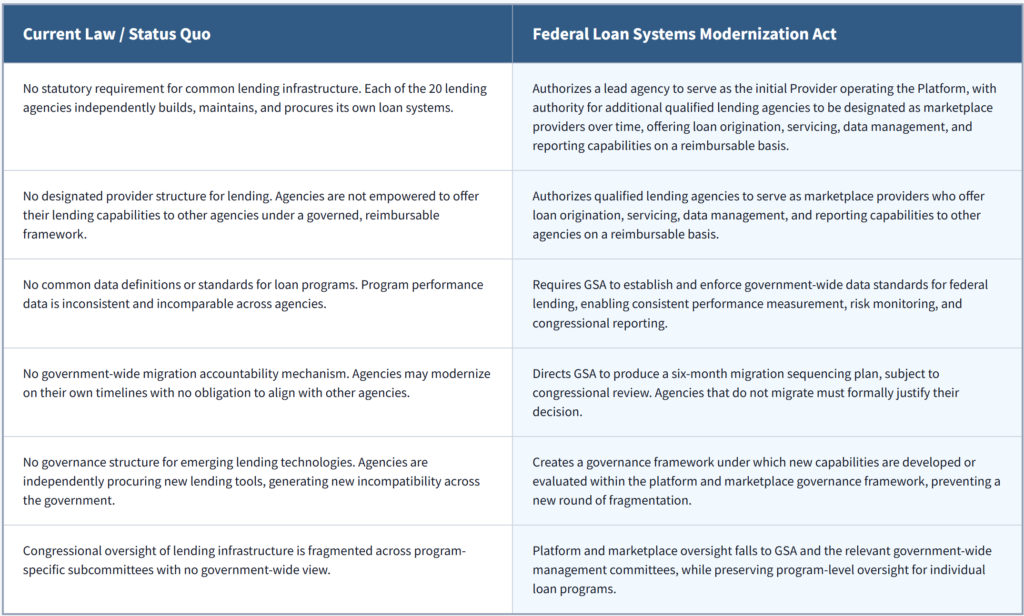
III. Frequently Asked Questions
Legislative Basics
Q: What is the main purpose of this bill?
The bill authorizes the creation of Lending.gov, a centralized loan platform built on commercially available loan management technology, to streamline how Americans access federal loan programs and how agencies administer them. GSA, in coordination with OMB and a designated lead agency, would establish the Platform within the first phase of implementation. Over time, the Platform is intended to mature into a shared services marketplace through which qualified provider agencies can offer loan origination, servicing, data management, and reporting capabilities to other agencies on a reimbursable basis. Agencies with direct loan portfolios would be required to migrate to the Platform within three years of enactment or formally justify an exemption.
Q: Why is this bill necessary now?
A number of converging dynamics create urgency. Lending agencies are currently operating a patchwork of fragmented systems to administer their programs, causing significant inefficiency and a poor borrower experience. Agencies are also actively procuring new lending systems and advanced technology tools independently, generating new incompatibility before any common framework exists. Every year of inaction narrows the window to establish common standards before the next generation of systems takes hold. Finally, the U.S. credit portfolio has grown substantially since the 2008 financial crisis, and the absence of common data infrastructure means the government cannot readily monitor that portfolio on an enterprise basis. The fiscal and oversight stakes have never been higher.
Q: Is this bill bipartisan?
Yes. The legislation reflects a broadly shared interest across both parties in modernizing federal financial management, reducing administrative fragmentation, and improving oversight of a $5 trillion portfolio. Government efficiency and fiscal responsibility are not partisan issues, and this bill addresses both. The bill is sponsored by Senators Blackburn and Hassan in the Senate and Congressmen Finstad and Krishnamoorthi in the House.
Q: Which committees have jurisdiction over this bill?
The Senate Committee on Homeland Security and Governmental Affairs and the House Committee on Oversight and Government Reform have authority over government-wide management, GSA, and federal IT and shared services policy, all of which are central to this bill. Individual loan program authorizations remain within the jurisdiction of the relevant program committees (e.g., Finance, Agriculture, Banking, Small Business, and Veterans Affairs).
The Lending.gov Platform
Q: How does the bill envision the Platform getting built?
The bill directs GSA to submit a plan within six months of enactment to establish the Platform using commercially available loan management technology, consistent with the commercial item preference in 41 U.S.C. § 3307. The plan must designate a lead agency to serve as the initial Provider and operational host, identify the federal loan programs that are candidates for integration, document common deficiencies and wasteful spending in existing systems (drawing on IG and GAO findings), and propose the Platform’s operational framework. The bill is explicit that modernization focuses on back-office functions such as application intake, underwriting, servicing, document handling, and fraud detection. It does not change any agency’s program authority.
Q: Why start with commercially available technology rather than custom development?
Custom federal IT development has a long track record of cost overruns and delayed delivery. Commercial loan management software is mature, widely deployed in the private sector, and already incorporates capabilities federal lenders need, including identity verification, data matching, standardized underwriting workflows, and fraud analytics. Starting with commercial technology lets the government adopt proven tools quickly, reduce program risk, and avoid recreating capabilities the market already offers. Several federal lenders have already used commercial loan technology with strong results, providing a foundation that can be scaled across the government.
Q: Who is likely to serve as the initial Provider?
The bill leaves that decision to GSA in consultation with OMB. While CUSAL takes no position on provider selection, the most plausible candidates are agencies with recent experience operating modern lending technology at scale, including SBA (which has substantially modernized its disaster lending and 7(a) operations since the pandemic), Treasury (which already operates Pay.gov and has deep financial systems experience), and GSA itself (which runs Login.gov and other shared services platforms). The initial Provider would be responsible for standing up, operating, and continuously improving the Platform.
The Shared Services Marketplace Model
Q: How does the Platform evolve into a shared services marketplace?
The Platform begins with a single lead agency serving as the initial Provider. As capabilities mature and additional agencies migrate, the bill contemplates a broader marketplace structure under which qualified lending agencies can also serve as providers on a reimbursable basis. This mirrors the path of federal payroll shared services, which started with a small set of designated providers and matured into a competitive marketplace under common standards. The marketplace model creates capacity, redundancy, and competitive discipline that a single-provider model would not.
Q: How does the agency-as-provider model work?
Qualified lending agencies, those with demonstrated operational expertise, can apply for designation as marketplace providers. Provider agencies offer lending infrastructure services to customer agencies on a reimbursable basis through interagency service agreements. This mirrors the structure of federal payroll shared services, where designated provider agencies serve numerous customer agencies under common standards. Customer agencies retain their program authorities; provider agencies supply the infrastructure.
Q: Which agencies are likely to become marketplace providers?
Like with the choice of an initial provider, agencies with deep experience in lending operations are the natural provider candidates, including Treasury, SBA, and potentially HUD (particularly if the concept is extended to guarantee agencies in the future). Agencies with smaller or less developed credit programs are more likely to be customers. CUSAL takes no position on provider selection.
Q: What is the value of a competitive marketplace?
A competitive marketplace creates incentives for quality and cost discipline. Customer agencies can choose from qualified providers based on capability, cost, and fit with their program requirements. This is the same logic behind the federal payroll model, where providers compete for agency customers. Competition within a governed framework produces better outcomes than either fragmented agency procurement or mandatory consolidation onto a single system.
Q: When does the bill take effect?
The bill takes effect upon enactment. The bill requires GSA to deliver a migration sequencing plan within six months of enactment, subject to congressional review. Ongoing reporting requirements provide Congress with visibility into migration progress, provider performance, and agency compliance with the migrate-or-justify standard. Agencies that seek exemptions must document their justification and submit it to GSA and the relevant committees.
Duplication of Existing Programs and Authority
Q: Does this bill duplicate existing federal shared services programs?
No. Existing shared services programs, including the Financial Management Quality Service Management Office (FM QSMO) operated by Treasury’s Bureau of the Fiscal Service, address financial management and accounting systems. The Federal Loan Systems Modernization Act addresses lending-specific infrastructure: loan origination, servicing, data management, and credit program operations. These are adjacent but distinct functional areas. The bill is designed to complement, not duplicate, existing shared services frameworks.
Q: Does this overlap with the FM QSMO marketplace?
The FM QSMO marketplace, operated by Treasury’s Bureau of the Fiscal Service, focuses on core financial management systems (e.g., general ledger, accounts payable, financial reporting, and related functions). Lending.gov addresses the operational systems specific to credit programs (e.g., loan origination, underwriting, disbursement, servicing, and default management). Agencies that participate in Lending.gov would still interact with the FM QSMO marketplace for their core financial management needs; the two systems would need to be designed for interoperability.
Q: Does this create a new federal agency?
No. The bill assigns governance responsibilities to GSA, an existing agency with established shared services experience. No new agency, bureau, or office is created. GSA’s role, in consultation with OMB, is to establish and enforce the marketplace governance framework (e.g., provider qualification standards, service-level requirements, data standards, and migration accountability), not to directly operate loan programs.
Effect on Existing Agency Authority
Q: Does this bill change agencies’ statutory lending authorities?
No. The bill explicitly preserves each agency’s statutory lending authorities, program rules, and borrower relationships. Agencies continue to set interest rates, determine eligibility, establish repayment terms, and make credit decisions under their existing authorizations. What changes is the technical infrastructure on which those authorities are exercised: agencies would operate on shared infrastructure rather than independently maintained systems.
Q: How does the bill affect the authority of program-specific oversight committees?
The bill does not alter the authority of program-specific oversight committees. Authorizing and appropriations subcommittees retain their oversight and funding responsibilities for the individual loan programs within their jurisdictions.
Q: Can agencies opt out of the platform or marketplace?
Not without formal justification. The bill establishes a migrate-or-justify standard: agencies with direct loan portfolios are presumed to be marketplace participants and must formally document a justification if they seek an exemption. Exemption requests are subject to review by OMB. This accountability structure is a deliberate departure from previous modernization efforts, which left participation decisions to agency discretion and produced limited consolidation as a result.
Q: What happens to existing IT investments and contracts?
The bill does not require agencies to terminate existing contracts or write off current investments. The sequencing plan is designed to align migrations with natural contract renewal cycles where possible, reducing unnecessary transition costs. Agencies with recent significant investments may be candidates for later migration phases or, in some cases, for exemption pending justification review
Fiscal Implications
Q: What are the expected cost savings?
The bill does not prescribe specific savings estimates, but the mechanism for savings is clear. Provider agencies operating at scale can deliver services at lower per-unit cost than smaller agencies maintaining their own systems. Elimination of redundant infrastructure reduces total government IT spending on lending systems over time. Reimbursable service agreements make the cost of lending infrastructure transparent and attributable in ways that current agency-by-agency spending is not, enabling better-informed appropriations decisions.
Q: How are transition costs overseen?
Migration costs are a real concern. The sequencing plan is designed to spread transitions over time and align them with natural contract renewal cycles. The bill does not create a dedicated transition fund, but agencies can use existing IT modernization authorities and fund mechanisms. Provider agency costs for standing up marketplace capabilities are recoverable through reimbursable agreements with customer agencies over time.
Q: Does this affect the Federal Credit Reform Act subsidy cost framework?
The bill does not amend the Federal Credit Reform Act. However, common data standards enforced across marketplace participants would improve the consistency and auditability of subsidy cost estimates which has been a longstanding weakness in federal credit accounting. A shared data infrastructure creates preconditions for more comparable cost estimates across programs without requiring changes to the underlying statute.
Oversight and Accountability
Q: How does Congress oversee the platform or marketplace?
The bill includes reporting requirements that give Congress visibility into migration progress. OMB is required to submit to the appropriate congressional committees an annual report on the status of agency migrations, any exceptions granted, the service levels provided to customer agencies of the platform, along with any recommended investments or policy changes required to improve the functionality of the platform. An analysis is also required of the long-term government-wide cost effectiveness of loan management.
Q: What safeguards exist against provider failure or deficient performance?
GSA and OMB will play an operational and oversight role in determining provider qualification standards and holding providers accountable for service continuity. Details to be included in service-level agreements between provider and customer agencies add to that accountability. The migrate-or-justify framework includes a pathway for agencies to seek alternative arrangements if a provider fails to meet standards. These safeguards are analogous to those governing the federal payroll shared services model and the FM QSMO marketplace.
Q: How does the bill address cybersecurity?
Consolidating lending infrastructure onto a governed platform or marketplace, rather than 20+ independently maintained agency systems, generally improves the government’s cybersecurity posture by reducing the attack surface and enabling consistent security standards to be applied across the portfolio. GSA’s provider qualification standards would include cybersecurity requirements consistent with CISA guidance and FISMA obligations. The bill does not create new cybersecurity authorities but operates within the existing federal cybersecurity framework.