An updated look at how the federal student loan portfolio faces a second wave of defaults. Here’s what the data show and what should happen next.
Key Findings
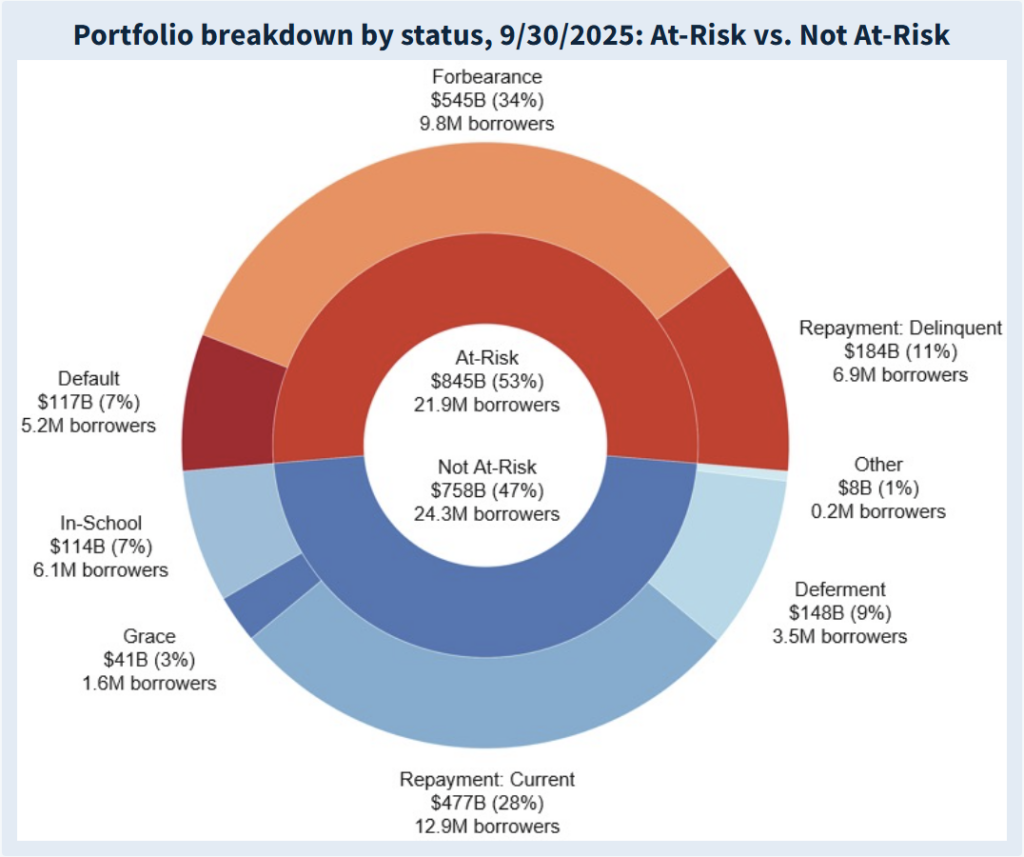
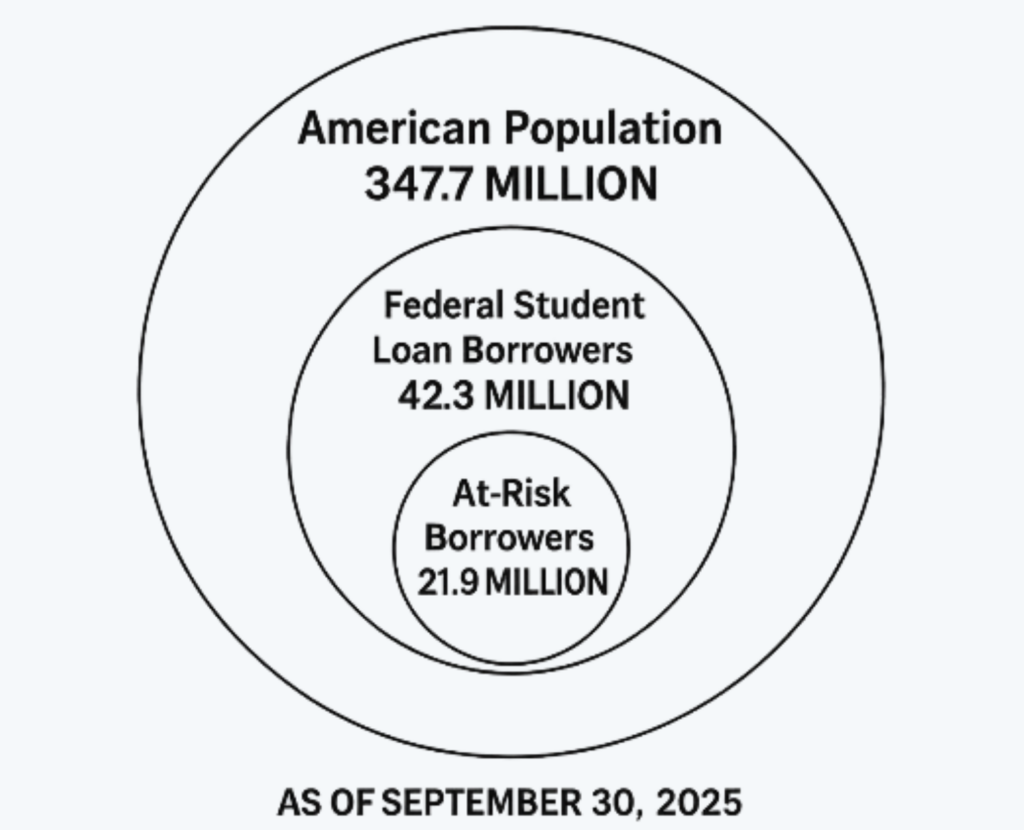
- The federal student loan portfolio held $845 billion in at-risk balances across 21.9 million borrowers as of September 30, 2025 — 6.3% of the U.S. population.
- Years of COVID-era forbearance have left millions of borrowers disconnected from repayment. With the expiration of those protections, defaults are rising.
- Initial default waves have already arrived. Borrowers in default surged from 5.2 million to 9.0 million between September 2025 and March 2026 — an increase of 3.8 million borrowers and $103 billion in outstanding balances in just six months.
- Additional waves are forming. Nearly 7 million borrowers in SAVE forbearance must transition into the new Repayment Assistance Plan this summer.
- Default carries serious consequences for borrowers — including credit-score declines ranging from 87 to 171 points, wage garnishment, and Treasury offsets — and for colleges facing loss of Title IV eligibility for persistently failing earnings-based accountability metrics.
- Without targeted intervention, future waves will collectively exceed the initial surge in scale. Five priorities can blunt them: earlier servicer engagement, automatic IDR enrollment, mandatory forbearance review, institutional accountability, and more frequent data analytics and publication.
The Congressional Research Service published a report last fall with an attention-grabbing title: The Potential Increase in Federal Student Loan Defaults in Fall 2025 (“Default Cliff”). The metaphor stuck. Advocates ran with it. The press picked it up. And now that we have data covering the period in question, it’s time to retire the cliff and replace it with something more accurate – and more sobering.
What’s actually happening in the federal student loan portfolio isn’t a default cliff. It’s a series of default waves. They are now forming and will continue to do so in the months ahead.
Default Cliff Defined
So first, let’s lay out the risks to the student loan portfolio and why the term default cliff was being used nine months ago. As of September 30, 2025, FSA reported that the federal student loan portfolio balance was $1.7 trillion of loans outstanding to 42.3 million Americans. Nearly $1.6 trillion of those loans are Direct Loan receivables owned and managed by the government, not guaranteed loans.
There are eight general statuses into which these loans fall:
- 1. In-school. Includes loans that have never entered into repayment as a result of the borrower’s enrollment in school.
- 2. Grace. Includes loans that have entered a six-month grace period after the borrower is no longer enrolled in school at least half-time. Borrowers are not expected to make payments during grace.
- 3. Repayment: Current. Includes loans in an active repayment status.
- 4. Repayment: Delinquent. Includes loans in an active repayment status but 31-360 days delinquent.
- 5. Deferment. Includes loans where payments have been postponed as a result of certain circumstances, such as returning to school, military service, or economic hardship.
- 6. Forbearance. Includes loans where payments have been temporarily suspended or reduced, often to help cover transition periods, while the borrower provides proper documentation or the lender/servicer reviews the documentation to determine the borrower’s eligibility for certain programs/benefits.
- 7. Default. Includes loans more than 360 days delinquent.
- 8. Other. Includes loans in non-defaulted bankruptcy and in a disability status.
Borrowers either current in repayment or in a status that does not require repayment (status shown as in-school, grace, repayment: current, deferment, or other) are considered broadly to be “Not At-Risk” of default.
Borrowers who are in or moving towards default (status shown as default, repayment: delinquent, or forbearance) are considered “At-Risk” of default. But why are loans in forbearance classified as being at risk? The answer requires a quick recap of student loan repayment policies during the 2020s.
Between March 2020 and October 2023, much of the federal student loan portfolio was moved into the forbearance status as a result of a COVID-19 related payment pause. For a year beyond the end date of that pause, any borrowers who went 90 days delinquent were automatically moved into a forbearance status again. That was done to allow time to communicate with borrowers as they came back into repayment and to provide time for the Biden administration to implement debt discharges.
Finally, any borrower who enrolled in the SAVE repayment plan was placed into forbearance until the courts made a final decision on the legality of the plan. As a result, the forbearance part of the portfolio once again grew. Given the amount of time that has passed since many of the borrowers in forbearance have made a payment, the likelihood of their delinquency and ultimate default has gone up considerably. However, there is little precedent to estimate exactly how many of those borrowers in forbearance may ultimately slip into default, even though there is a general concern that the percentage will be high.
Given the above, the term default cliff has been used to refer to the risk that a large volume of borrowers moves from forbearance into default in a compressed period of time. However, as discussed below, a surge in defaults is not likely to occur suddenly. Instead, waves of defaults are expected as policy-driven forbearance protections expire or are withdrawn.
Regardless of the metaphor used, unlike a typical default cycle – where delinquencies build incrementally and servicers have time to intervene – current conditions suggest a default surge could overwhelm default servicer and collections capacity, trigger large increases in credit losses, and cause cascading financial hardship for borrowers. The concern is not simply that defaults will be high in absolute terms, though they likely will be, but that the concentration of borrowers moving from non-payment to default status in a short window creates operational and fiscal risks that the system is ill-equipped to absorb.
What Do the Numbers Show?
In the analysis below, borrowers are categorized as being Not At-Risk (in-school, grace, current repayment, deferment, and other non-defaulted statuses) or At-Risk (delinquent, in forbearance, and in default). As of last September, the at-risk portion of the portfolio totaled $845 billion in outstanding loans held by 21.9 million borrowers — or 6.3% of the American population.
The table below tracks the portfolio mix and shows the number of borrowers and outstanding balances in each loan status category, along with the percentage change from FY2025-Q4 through FY2026-Q2.
Portfolio Mix by Loan Status: FY2025-Q4 through FY2026-Q2
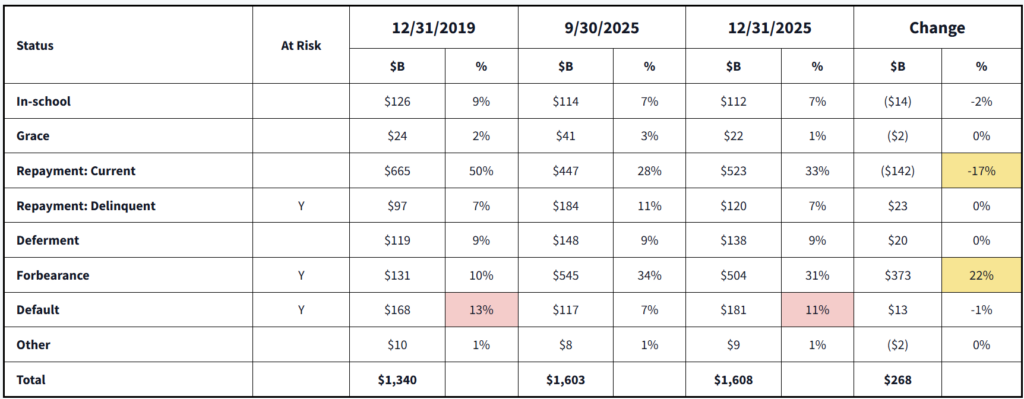
The data tell a clear story. From the end of last fiscal year through the end of March 2026, a period of just six months, the number of borrowers in default rose from 5.2 million to 9.0 million, an increase of 3.8 million borrowers and $103 billion in outstanding balances. It did not arrive as a cliff — a single catastrophic drop — but as a surge, building across two quarters as the payment pause protections that had kept millions of borrowers in forbearance were withdrawn.
At the same time, the forbearance population declined from 9.8 million to 8.4 million borrowers — a reduction of 1.4 million. Some of those borrowers successfully transitioned into current repayment, which grew by 1.3 million borrowers over the same period. But the math shows that the decline in forbearance is far smaller than the increase in default, which means a significant share of borrowers who left forbearance went directly into delinquency or default rather than returning to repayment.
Another default wave is now forming. Of the 8.4 million borrowers still in forbearance as of FY2026-Q2, a substantial portion remain there because of the SAVE litigation — borrowers enrolled in a repayment plan that courts have vacated, waiting to be transitioned into IBR or the new Repayment Assistance Plan under OBBBA. That transition is underway, but it is moving a large and financially stressed population into an unfamiliar repayment structure with limited servicer capacity to support them. The delinquent population, meanwhile, has declined sharply (from 6.9 million to 3.5 million borrowers) not because those borrowers became current, but because many of them crossed the 360-day threshold and moved into default.
The wave metaphor earns its keep precisely because the data show sequential surges rather than a single event. The cliff may be behind us. The waves are still rolling.
What Happens to Borrowers Who Default?
The consequences for the 21.9 million at-risk borrowers aren’t abstract. In December 2025, TICAS published the results of a survey of student loan borrowers in repayment status. Those findings reflect the repayment population, which includes a large share of borrowers not yet at risk. The picture for the at-risk population is almost certainly worse.
- 42% report their loans have negatively affected their ability to cover basic needs. Affects 18 million Americans.
- 37% report negative effects on healthcare costs for themselves or dependents. Affects 16 million Americans.
- 52% report negative effects on their ability to save for retirement. Affects 22 million Americans.
- 45% report negative effects on housing plans. Affects 19 million Americans.
In addition, the CRS report cites the following consequences for slipping into default:
- ED reports the default to consumer reporting agencies. Consumer reporting agencies may report information on the status of a borrower’s defaulted student loan for seven years from the date of the default.
- Up to 15% of a borrower’s disposable pay may be garnished (often referred to as administrative wage garnishment – AWG). Disposable pay is the part of a borrower’s compensation that remains after deducting amounts required by law to be withheld.
- A borrower’s federal income tax refunds, Social Security benefits, and certain other federal benefits may be offset through the Treasury Offset Program (TOP).
- A borrower’s defaulted loan may be reported to the Credit Alert Verification Reporting System, a federal database of individuals who have defaulted on their debt that is used to prescreen applicant eligibility for various federal direct and guaranteed loans.
- A borrower may be subject to litigation to compel repayment. If this option is pursued, the U.S. Department of Justice may sue the borrower on behalf of ED.
- A borrower may be assessed collection charges, including loan collection fees, TOP processing fees, court costs, and attorney’s fees.
Taken together, these consequences are not merely punitive — they are self-reinforcing. A borrower who defaults faces damaged credit, garnished wages, and seized tax refunds simultaneously, each compounding the others and making recovery progressively harder. For borrowers already managing tight budgets, those consequences ripple quickly into healthcare affordability, housing stability, and retirement security. Moreover, the social consequences of default extend well beyond personal finance.
Research consistently links financial distress to elevated rates of marital breakdown, family instability, and domestic conflict — including child abuse and neglect, which rise measurably during periods of household financial crisis. Borrowers in default face damaged credit that functions as a barrier to basic economic participation: landlords routinely reject rental applications from applicants with derogatory credit histories, and employers in a wide range of industries conduct credit checks as part of hiring — meaning that default can simultaneously cost a borrower their financial footing and impede their ability to earn their way back to stability.
The result is a compounding trap: default triggers consequences that make recovery harder, which deepens financial distress, which generates further social strain. On a scale of millions of borrowers, these are not individual misfortunes; they are a systemic failure with measurable costs to families, communities, and the broader economy.
The coming default waves risk creating a permanent underclass of Americans: citizens who, through a combination of policy failure and institutional neglect, find themselves locked out of the financial mainstream with diminishing prospects for recovery.
What Happens to Schools?
The institutional stakes are significant as well. Title IV eligibility, which drives access to Pell grants and Direct Loans (the financial oxygen of many colleges and universities), is conditioned in part on cohort default rates (CDRs). An institution whose CDR reaches 40% in a single year, or 30% for three consecutive years, loses its eligibility to participate.
CDRs have been artificially suppressed during the COVID payment pause because borrowers couldn’t default on loans they weren’t required to repay. That phenomenon is ending. The first CDRs that will capture post-pause defaults won’t be published by the Department of Education until September 2026, but the nonpayment rate data ED published in February 2026 offers a preview.
Sample of IHEs with highest nonpayment rates
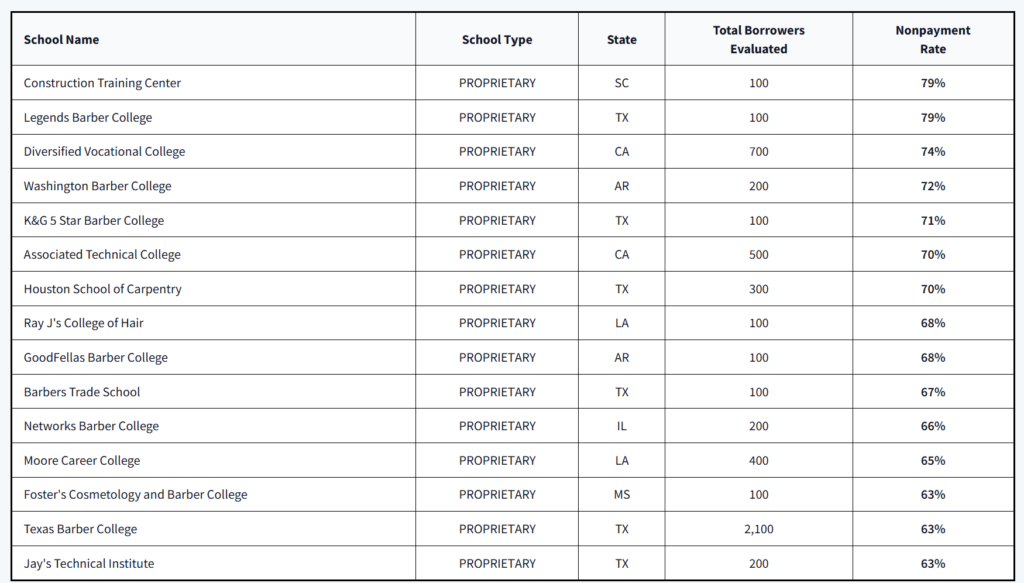
Nonpayment rates represent the share of an institution’s Direct Loan borrowers who were more than 90 days delinquent as of mid-May 2025. Some analysts have called them a reasonable CDR proxy. They are not binding since institutions don’t lose Title IV eligibility based on nonpayment rates alone, but they are directionally significant.
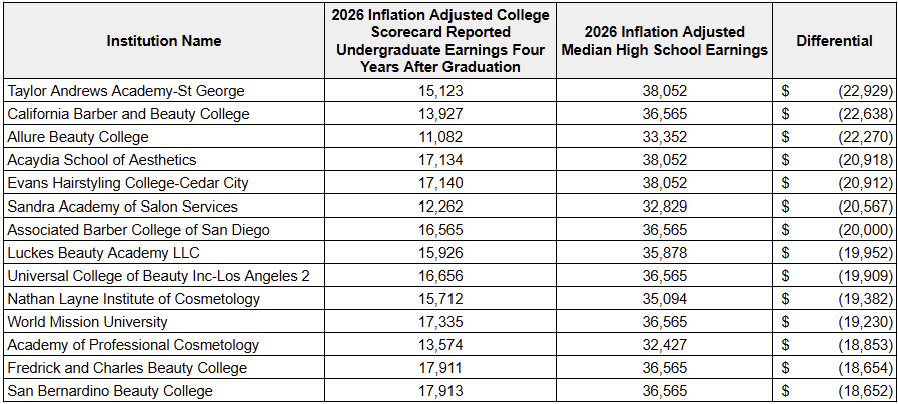
Compounding this is the Earnings Test, which FSA is now implementing. Programs at institutions with negative earnings differentials for two out of three years lose Direct Loan eligibility. As of March 2026, 999 of 5,826 Title IV-eligible undergraduate institutions, or 17%, showed negative aggregated Earnings Test metrics.
Sample of IHEs with worst Earnings Test metrics
To put this in context, below is a graph illustrating the Earnings Test for 4,948 undergraduate institutions out of a total of 5,826 that have available data as of March 2026. Graduating from most institutes of higher education (IHEs) still represents a significant benefit to borrowers as seen by the tail of this chart where students at 3,949 IHEs earn between $0 and $136,167 more annual salary than relevant high school graduates.
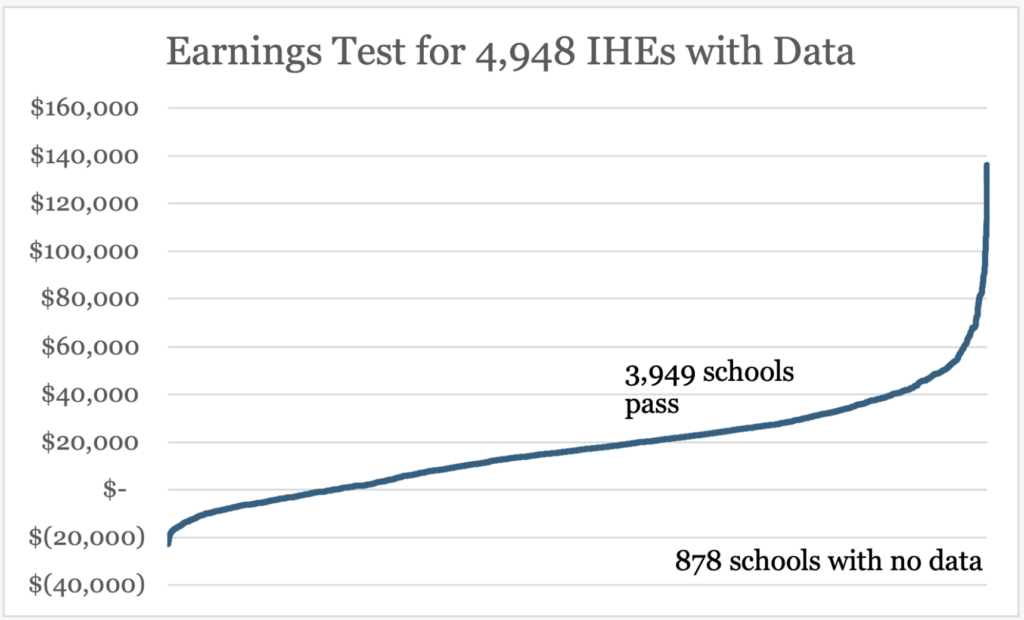
While this level of institutional accountability will reduce student loan defaults in the long-term, it will create a short-term shock to the post-secondary education environment that will negatively impact students attending those institutions.
What Happens to the Economy?
With 21.9 million borrowers and $845 billion of balances in at-risk statuses, this is no longer just an education-finance issue — it’s a variable with the potential to adversely impact the national economy. Rising student loan delinquencies and defaults affect consumer demand and credit access – in addition to increasing annual budget deficits – as this class of distressed loan assets touches more than one in eight American adults.
Disposable income. A 2025 Federal Reserve analysis of the payment restart found that the return to repayment reduced consumer spending by roughly $80 billion at an annual rate (0.3% of GDP). Applying that sensitivity to the current portfolio suggests the next repayment wave could plausibly subtract tens of billions annually from consumer spending.
That drag concentrates among the least financially flexible households. Data from the New York Federal Reserve Bank shows that newly defaulted borrowers saw credit-score declines ranging from 87 points for those already in subprime territory to 171 points for those with superprime scores — enough to push even borrowers with solid financial histories out of mainstream credit access entirely. Among those borrowers, delinquency rates on other debt spiked to nearly 40% on auto loans, 56% on credit cards, and 20% on mortgages. The Fed’s own conclusion is that this isn’t broad financial contagion given these borrowers hold a small share of total balances. But it is concentrated financial deterioration across millions of households, with real effects on local economies and lenders serving lower- and middle-income borrowers.
Housing. A Federal Reserve study tracking student loan borrowers found that a 10% increase in student debt causes a 1-to-2 percentage point drop in homeownership rates during the first five years after leaving school — and that was measuring debt burden alone, under pre-pandemic conditions. In the current environment, the mechanism is more severe: it measured only the impact of debt burden on homeownership rates, not the additional drag from delinquency, default, and the severe credit-score declines that now accompany them. The true impact on homeownership is almost certainly larger than the study alone would suggest.
Federal budget. Defaulted student loans are federal assets. As defaults exceed loan performance expectations, additional costs to taxpayers accrue. Those costs are real. With roughly $181 billion in defaulted balances, every 10-point deterioration in expected repayment value implies about $18 billion in federal asset impairment. And that translates directly into higher federal borrowing and additional pressure on a debt service burden that is already historically elevated.
Overall economic impact. Unlike the 2008 financial crisis, this is unlikely to destabilize the financial system. But default waves can subtract tens of billions from annual consumer spending, damage credit access for millions of borrowers, soften housing demand at the margin, and impose real costs on the federal balance sheet. In a $29 trillion economy, that’s not a collapse but it’s a material headwind, concentrated among households least able to absorb it.
What Should Actually Happen?
A problem of this scale and complexity requires targeted intervention, not broad gestures. Five priorities stand out.
First, earlier servicer engagement with non-paying borrowers that have clearer, simpler pathways into income-driven repayment would reduce preventable defaults before they occur. The SAVE forbearance backlog requires a managed transition strategy, not a cliff of its own making.
Second, automatic income-driven repayment enrollment for borrowers who become delinquent, paired with simplified annual recertification, would remove friction at the moment it matters most. Done right, this is the single intervention most likely to moderate the size of future waves.
Third, long-term forbearance should trigger mandatory repayment review rather than passive accumulation. The SAVE forbearance was the right emergency response to litigation uncertainty, but nearly 7 million borrowers currently sitting in that status without active repayment planning is a large wave-in-waiting.
Fourth, on the institutional side, IHEs with persistently high nonpayment rates should be required to submit default prevention plans well before sanctions become available — intervention before penalty, not instead of it.
Fifth, across all of this: better data and data analytics, published more regularly. The gap between September 2025 and the first post-pause CDRs in September 2026 is a year of policy blindness. Regular analytics and publication of delinquency, forbearance, and repayment transition data — the kind of transparency that FSA could provide routinely before recent capacity reductions — would allow policymakers, servicers, and institutions to respond to risk rather than reconstruct it after the fact.
What Are the Stakes?
The federal student loan system isn’t collapsing. But it is carrying a level of borrower distress that is concentrated, compounding, and now beginning to express itself in default data. And the extent of this problem is economically material. The initial waves have arrived. Others are forming.
The cliff metaphor implied a single moment of reckoning. Waves are different. They keep coming. And the question is whether the policy response catches up to that reality.
This report was written by Jay Hurt, former CFO at the U.S. Department of Education’s Office of Federal Student Aid, and Doug Criscitello, former CFO at the U.S. Department of Housing and Urban Development. Both authors are currently working with the Center for USA Lending, a nonprofit organization focused on advancing the modernization of federal lending.