The federal student loan portfolio faces a second wave of defaults. Here’s what the data show and what should happen next.
Key Findings
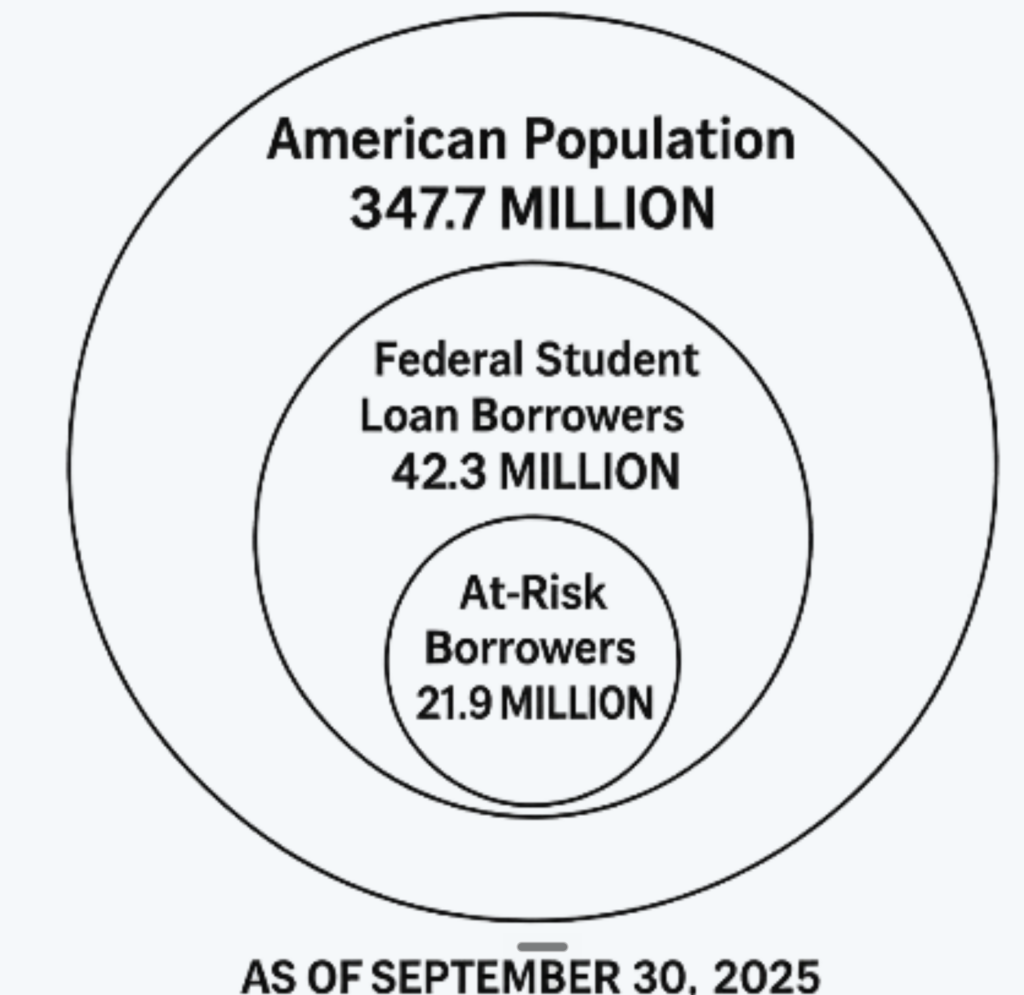
- The federal student loan portfolio held $845 billion in at-risk balances across 21.9 million borrowers as of September 30, 2025 — or 6.3% of the U.S. population.
- Default wave #1 has already arrived: roughly 2.5 million borrowers entered default last quarter. Wave #2 is forming as 7.5 million SAVE forbearance borrowers transition into the new Repayment Assistance Plan this summer.
- Default carries substantial negative implications for borrowers (credit-score declines averaging 91 points, wage garnishment, Treasury offsets) and colleges (reduced Title IV eligibility for institutions with high nonpayment rates) alike.
- Five priorities can blunt wave #2: earlier servicer engagement, automatic IDR enrollment, mandatory forbearance review, institutional accountability, and more frequent data publication.
The Congressional Research Service published a report last fall with an attention-grabbing title: The Potential Increase in Federal Student Loan Defaults in Fall 2025 (“Default Cliff”). The metaphor stuck. Advocates ran with it. The press picked it up. And now that we have data covering the period in question, it’s time to retire the cliff and replace it with something more accurate — and more sobering.
What’s actually happening in the federal student loan portfolio isn’t a default cliff. It’s a series of default waves. And the second one is building.
What Do the Numbers Show?
As of September 30, 2025, the Federal Student Aid data center reported $1.6 trillion in federally managed direct loan receivables owed by 42.3 million Americans to the government. Those loans fall into eight status categories, from in-school and grace period through current repayment, deferment, forbearance, delinquency, and default.
The clearest way to understand the current risk profile is to sort those categories into two buckets: Not At-Risk (in-school, grace, current repayment, deferment, and other non-defaulted statuses) and At-Risk (delinquent, in forbearance, and in default). As of last September the at-risk portion of the portfolio totaled $845 billion in outstanding loans held by 21.9 million borrowers — or 6.3% of the American population.
Portfolio breakdown by status, 9/30/2025: At-Risk vs. Not At-Risk
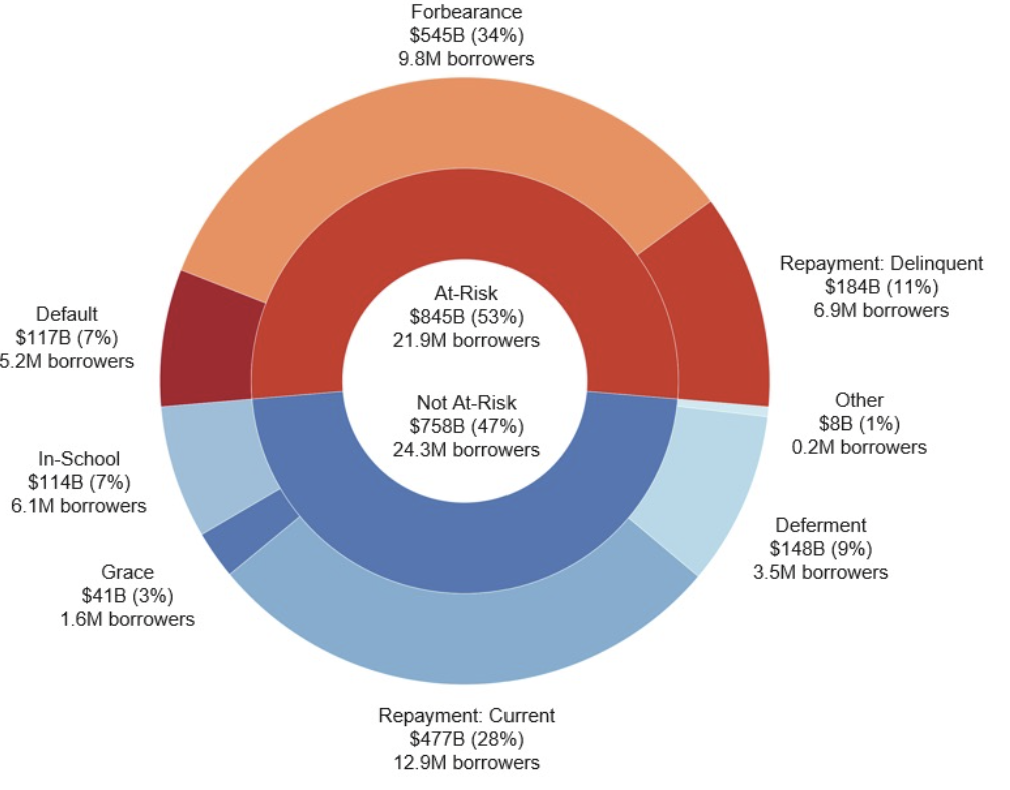
That at-risk number is striking on its own. But consider a three-date comparison — December 2019, September 2025, December 2025 — and the wave metaphor earns its name.
Portfolio mix comparison across three dates
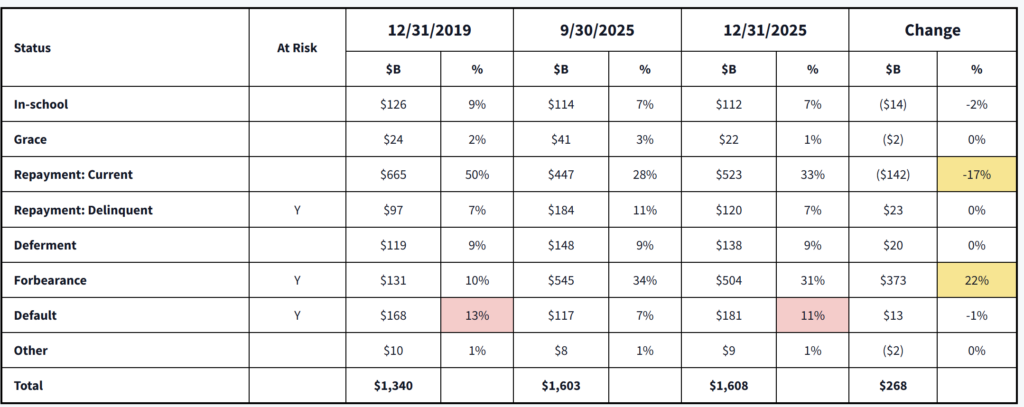
Here’s why the cliff framing misses the mark. The portfolio mix at the end of December 2025 (highlighted in red) looks comparable to December 2019 on defaults, but with two major differences. The share of borrowers in current repayment is 17 percentage points lower, while the share in forbearance is 22 percentage points higher (highlighted in orange in the table above).
In other words, we have seen default wave #1 this past quarter with 2.5 million borrowers entering default. Now default wave #2 is queuing up as the government tries to move 7.5 million borrowers in SAVE forbearance into repayment under the new Repayment Assistance Plan (RAP) established by last year’s OBBBA reconciliation legislation.
If the default cliff is behind us, the waves are still crashing.
Federal student loan borrowers and the at-risk population, 9/30/2025
What Happens to Borrowers Who Default?
The consequences for the 21.9 million at-risk borrowers aren’t abstract. A December 2025 survey by the Institute for College Access and Success (TICAS) found, even among borrowers still nominally in repayment, that 42% report their loans have negatively affected their ability to cover basic needs, 52% say they’ve been unable to adequately save for retirement, 45% report their debt has affected their housing plans, and 37% have had difficulty covering healthcare costs for themselves or their dependents. Scale those percentages to the full at-risk population and the numbers are staggering — 18 to 22 million Americans affected across each category.
For borrowers who formally enter default, the government’s collection toolkit is substantial and largely automatic. Administrative wage garnishment (AWG) can claim up to 15% of disposable pay. Federal tax refunds and certain federal benefits can be offset through the Treasury Offset Program (TOP). Defaults are reported to consumer credit agencies for seven years. Some states can revoke professional licenses for borrowers who default on federal student loans: a consequence that directly affects labor market participation and geographic mobility in ways that compound over time. Borrowers may also face litigation by the Department of Justice on behalf of the Department of Education, with collection costs, court fees, and attorney’s fees added to the original balance.
The federal government paused AWG and TOP in January 2026, but the rest of the collection apparatus remains fully operational. TOP and AWG will likely be turned on again shortly after the RAP repayment plan is made available to borrowers, planned for July 1, 2026.
What Happens to Schools?
The institutional stakes are significant as well. Title IV eligibility, which drives access to Pell grants and direct loans (the financial oxygen of many colleges and universities), is conditioned in part on cohort default rates (CDRs). An institution whose CDR reaches 40% in a single year, or 30% for three consecutive years, loses its eligibility to participate.
CDRs have been artificially suppressed during the COVID payment pause because borrowers couldn’t default on loans they weren’t required to repay. That phenomenon is ending. The first CDRs that will capture post-pause defaults won’t be published by the Department of Education until September 2026, but the nonpayment rate data ED published in February 2026 offers a preview.
Sample of IHEs with highest nonpayment rates
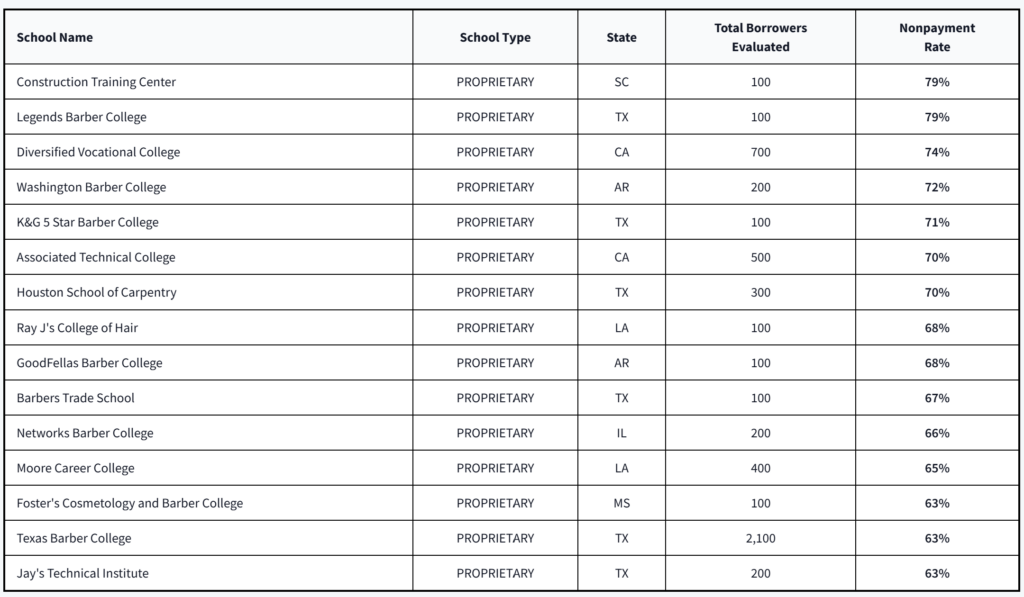
Nonpayment rates represent the share of an institution’s direct loan borrowers who were more than 90 days delinquent as of mid-May 2025. Some analysts have called them a reasonable CDR proxy. They are not binding since institutions don’t lose Title IV eligibility based on nonpayment rates alone, but they are directionally significant.
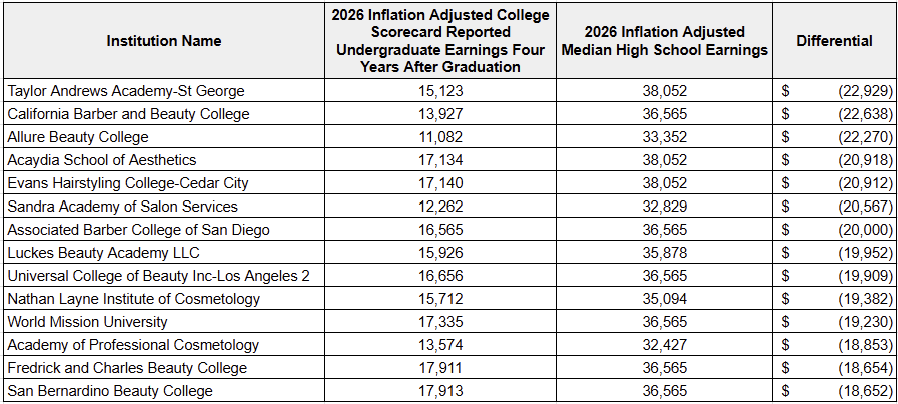
Compounding this is the Earnings Test, which FSA is now implementing. Programs at institutions with negative earnings differentials for two out of three years lose direct loan eligibility. As of March 2026, 999 of 5,826 Title IV-eligible institutions, or 17%, showed negative aggregated Earnings Test metrics.
Sample of IHEs with worst Earnings Test metrics
What Happens to the Economy?
With 21.9 million borrowers and $845 billion of balances in at-risk statuses, this is no longer just an education-finance issue — it’s a variable with the potential to adversely impact the national economy. Rising student loan delinquencies and defaults affect consumer demand and credit access – in addition to increasing annual budget deficits – as this class of distressed loan assets touches more than one in eight American adults.
Disposable income. A 2025 Federal Reserve analysis of the payment restart found that the return to repayment reduced consumer spending by roughly $80 billion at an annual rate (0.3% of GDP). Applying that sensitivity to the current portfolio suggests the next repayment wave could plausibly subtract tens of billions annually from consumer spending.
That drag concentrates among the least financially flexible households. Data from the New York Federal Reserve Bank shows that newly defaulted borrowers saw average credit-score declines of 91 points — enough to move someone from marginally bankable to effectively excluded from mainstream credit. Among those borrowers, delinquency rates on other debt spiked to nearly 40% on auto loans, 56% on credit cards, and 20% on mortgages. The Fed’s own conclusion is that this isn’t broad financial contagion given these borrowers hold a small share of total balances. But it is concentrated financial deterioration across millions of households, with real effects on local economies and lenders serving lower- and middle-income borrowers.
Housing. A Federal Reserve study tracking student loan borrowers found that a 10% increase in student debt causes a 1-to-2 percentage point drop in homeownership rates during the first five years after leaving school — and that was measuring debt burden alone, under pre-pandemic conditions. In the current environment, the mechanism is more severe: it’s not just debt load but delinquency, default, and a 91-point average credit-score decline that can move a borrower from marginally bankable to effectively excluded from a mortgage. Moreover, that study likely understates the current effect, because it captures only one of the channels now operating simultaneously.
Federal budget. Defaulted student loans are federal assets. As defaults exceed loan performance expectations, additional costs to taxpayers accrue. Those costs are real. With roughly $181 billion in defaulted balances, every 10-point deterioration in expected repayment value implies about $18 billion in federal asset impairment. And that translates directly into higher federal borrowing and additional pressure on a debt service burden that is already historically elevated.
Overall economic impact. Unlike the 2008 financial crisis, this is unlikely to destabilize the financial system. But default waves can subtract tens of billions from annual consumer spending, damage credit access for millions of borrowers, soften housing demand at the margin, and impose real costs on the federal balance sheet. In a $29 trillion economy, that’s not a collapse but it’s a material headwind, concentrated among households least able to absorb it.
What Should Actually Happen?
A problem of this scale and complexity requires targeted intervention, not broad gestures. Five priorities stand out:
Earlier servicer engagement with delinquent borrowers that have clearer, simpler pathways into income-driven repayment would reduce preventable defaults before they occur. The SAVE forbearance backlog requires a managed transition strategy, not a cliff of its own making.
Automatic income-driven repayment enrollment for borrowers who become delinquent, paired with simplified annual recertification, would remove friction at the moment it matters most. Done right, this is the single intervention most likely to keep wave two from reaching the scale of wave one.
Long-term forbearance should trigger mandatory repayment review rather than passive accumulation. The SAVE forbearance was the right emergency response to litigation uncertainty, but 7.5 million borrowers sitting in that status without active repayment planning is a wave-in-waiting.
On the institutional side, colleges with persistently high nonpayment rates should be required to submit default prevention plans well before sanctions become available — intervention before penalty, not instead of it.
And across all of this: better data, published more regularly. The gap between September 2025 and the first post-pause CDRs in September 2026 is a year of policy blindness. Regular publication of delinquency, forbearance, and repayment transition data — the kind of transparency FSA provided routinely before recent capacity reductions — would allow policymakers, servicers, and institutions to respond to risk rather than reconstruct it after the fact.
What Are the Stakes?
The federal student loan system isn’t collapsing. But it is carrying a level of borrower distress that is concentrated, compounding, and now beginning to express itself in default data. And the extent of this problem is economically material. The first wave arrived. The second is forming.
The cliff metaphor implied a single moment of reckoning. Waves are different. They keep coming. And the question is whether the policy response catches up to that reality.
This report was written by Jay Hurt, former CFO at the U.S. Department of Education’s Office of Federal Student Aid and Doug Criscitello, former CFO at the U.S. Department of Housing and Urban Development. Both authors are currently working with the Center for USA Lending, a nonprofit organization focused on advancing the modernization of federal lending.